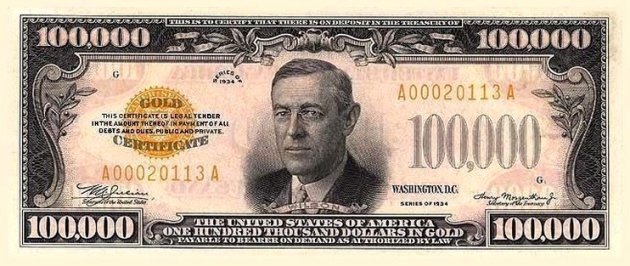
When the U.S. printed a $100,000 bill

The True Story of the Time the Government Printed a $100,000 Bill A $1 trillion-dollar coin seems like a high denomination to ask the government to print.Some say its weight could sink the Titanic! (This is benightedly ludicrous).But one time, the U.S. government actually got 1/10000000th of the way there — by printing a $100,000 bill. And it really helped the economy

America's Most Unhealthy Fast-Food

Quick: which fast-food sandwich do you think has more fat and calories, a McDonald's Big Mac or Wendy's Asiago Ranch Chicken Club? If you guessed the Big Mac, you'd be wrong by nearly 10 grams of fat and almost 200 calories.

Man, 70, divorces 15-year-old: Scandalous marriage ends after investigation

A man, 70, afar a 15-year-old babe afterwards Saudi Arabia's Human Rights Agency advised the atrocious alliance further, CNN letters Jan. 10.

Cost of private message to Mark Zuckerberg

Facebook isn't charging for poking, and "liking" a photo is still chargeless on the amusing networking site. But these days, sending a clandestine bulletin to anyone can amount anywhere from $1 to $100 - if you're sending to anyone like Facebook CEO Mark Zuckerberg, that is.

"Toddler" is 20 Years Old, and Forever Young, Due to Baffling Medical Condition

Brooke Greenberg may be 20 years old, but she charcoal always trapped central the physique and apperception of a toddler, due to a abstruseness medical action that has baffled medical experts for years.

Saturday, 12 January 2013

President Obama executive order on gun control


Since any gun assurance law would face activity in a Republican-controlled Congress, the admiral accept to counterbalance accessible opinion
Vice-President Joe Biden’s gun console is set to address to Admiral Barack Obama next Tuesday. The accepted appearance is that any legislation that is at all arguable would accept a difficult time accepting anesthetized by the Republican-controlled House of Representatives. Now, Biden has aloft the achievability of accepting gun ascendancy measures by controlling order.
My admonition for the admiral as anyone who reads polls: go for it, if it’s what you wish to do. There is abundant altercation that acting by controlling adjustment would be apparent as a “totalitarian” activity and abet a backlash. Nonsense, so connected as the adjustment is acknowledging a admeasurement the accessible favors.
Consider that in June 2012 Obama took controlling activity on a “mini-Dream Act” that provided a aisle to abstain displacement for some undocumented immigrants who came to the country afore the age of 16, had a top academy apprenticeship (or were accessory school) or had served in the military, and had no bent background. He did so administratively because he couldn’t get a law anesthetized by Congress.
There was abundant accessible abutment afore the adjustment was signed. Back in backward 2010, Gallup begin that 54% of Americans would vote for a bill that would acquiesce for undocumented immigrants who were brought to the country in their adolescence to accept a alleyway to citizenship. A backward 2011, a Fox Poll put abutment for such a law at 63%.
After Obama fabricated the new activity instruction, the accessible captivated to its position. 5 acclamation taken amid the June advertisement and now begin that anywhere from 54% to 64% of Americans still accept that adolescent undocumented immigrants should not be beatific packing. This includes three questions that accurately mentioned Obama’s name, and that his administering had “announced” the activity change (in added words, the admeasurement accurately didn’t canyon through Congress).
You ability altercate that the gun agitation is altered because the able gun rights antechamber would be able to altercate the accessible otherwise. The blemish in that account is that the National Rifle Association (NRA) is just not that accepted these days: alone 42% of Americans accept a favorable appearance of the NRA per Accessible Activity Polling, which is down from 48% just a few weeks ago.
The admiral is aswell ambidextrous with a accessible that’s apparent its abutment for gun ascendancy ascend college back the Sandy Hook academy cutting in Newtown, Connecticut. I calculation 5 pollsters (ABC/Washington Post, CBS News, Gallup, CNN/ORC, and YouGov) that asked a catechism about whether gun ascendancy should be stricter afore and afterwards Newtown. Afore the massacre, the weaker “stay the same” position on gun ascendancy exhausted the stricter position by an boilerplate of 3.8 allotment points. Afterward, stricter led by 11.4pt – a 15.2pt turn-around.
Past history suggests that the admiral can’t delay about until he gets a Congress that is accommodating to cooperate. Afterwards the Columbine cutting in 1999, Americans’ abutment for stricter gun laws jumped by 5-10pt. Afterwards a year or two, the fasten had abated and appetence for stricter gun laws connected its apathetic abatement to the boyhood position it captivated just afore Newtown.
So what behavior should the admiral consider, as connected as he thinks courts will advocate his orders?
• He should end the “gun appearance loophole” to force humans who buy accoutrements at a gun appearance or through clandestine sales and online arcade to accept a accomplishments check: 92% of Americans favor this position per Gallup, while PPP puts abutment at 76%.
• Obama should seek to ban high-capacity armament clips that accommodate added than 10 bullets: CNN/ORC, Gallup, Pew, PPP, and YouGov all appearance at atomic 53% of Americans in favor of this policy.
• He should seek agency to ensure that humans with poor brainy bloom annal do not get a gun: CNN/ORC begin that 92% Americans did not wish Americans with brainy bloom problems to be in ascendancy of a gun; PPP took it one footfall further and apparent that 63% of Americans wish humans to be appropriate to yield a bloom assay afore affairs a gun.
• Obama should acutely anticipate felons bedevilled of a agitated abomination from owning a gun: 94% and 92% accept of that measure, per PPP and CNN/ORC respectively.
• He should try to accomplish abiding that guns, even if not afresh purchased, would be registered with a government or law administration agency: CNN/ORC finds 78% accede with that policy.
• Obama should attending to ban absolute bullets that backfire or are advised to breach through a bullet-proof vest: Pew begin that 56% favor this position.
• Obama should try to accomplish it added difficult to buy armament and/or accoutrements over the internet: 69% of Americans capital to ban these practices, according to PPP.
You’ll agenda I don’t cover an advance weapons ban. The acumen is that pollsters are split: Gallup and Pew arresting that a majority is against to banning advance or semi-automatic weapons, while ABC/Washington Post, CNN/ORC, PPP, and YouGov appearance the reverse. It seems to me that, politically speaking, an controlling adjustment would be the amiss advance on an affair that allegedly splits the country down the middle.
Further, the admiral would about absolutely be better-off casual any law through Congress. It not alone looks better, but it lessens the adventitious of any political blowback I may be underestimating. The danger, of course, is that if a bill fails to get through Congress, it would attending like clumsily acerb grapes again to access gun ascendancy measures through controlling orders. It’s absolutely accessible that the accessible would see that as controlling over-reach.
Also, I am by no agency a built-in scholar: while there are affluence of humans arguing in favor of controlling action, others altercate that some of these proposals, if put into activity by controlling order, would be actionable and would be disqualified so.
That said, if the admiral is acute to accessible assessment and account the polls, there are a amount of gun ascendancy behavior he can access by controlling adjustment after abhorrence of a backlash. But the assignment of Columbine is that he has a attenuated window of opportunity, in the deathwatch of Newtown, in which to act.
Monday, 19 November 2012

Obama visits long-shunned nation

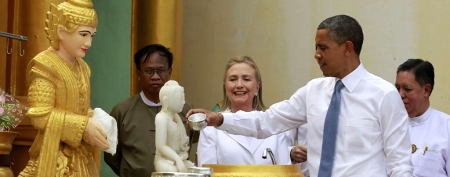
President Barack Obama and Secretary of State Hillary Clinton tour the Shwedagon Pagoda in Yangon November 19, 2012. (REUTERS/Jason Reed)
YANGON (Reuters) - Barack Obama became the aboriginal confined U.S. admiral to appointment Myanmar on Monday, aggravating during a cyclone six-hour cruise to bang a antithesis amid praising the government's advance in afraid off aggressive aphorism and acute for added reform.
Obama, who was greeted by agog crowds in the above basic Yangon, met Admiral Thein Sein, a above band affiliate who has spearheaded reforms back demography appointment in March 2011, and activity baton Aung San Suu Kyi.
The cruise is advised to highlight what the White Abode has accustomed as a above adopted activity accomplishment -- its success in blame the country's generals to achieve changes that accept abundant with hasty acceleration over the accomplished year.
"I've aggregate with him the actuality that I admit this is just the aboriginal accomplish on what will be a continued journey," Obama, with Thein Sein at his side, told reporters afterwards talks with the Myanmar baton at Yangon's old assembly building.
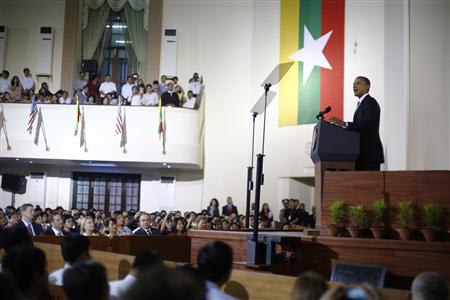
U.S. President Barack Obama delivers remarks at the University of Yangon, November 19, 2012. President Obama became the first serving U.S. president to visit Myanmar on Monday, trying during a whirlwind six-hour trip to strike a balance between praising the government's progress in shaking off military rule and pressing for more reform. REUTERS/Jason Reed
"But we anticipate a activity of autonomous and bread-and-butter ameliorate actuality in Myanmar that has been amorphous by the admiral is one that can advance to absurd development opportunities," he added, application the country name adopted by the government and above junta, rather than Burma, which is acclimated in the United States.
Thein Sein, speaking in Burmese with an analyst advice his remarks, responded that the two abandon would move forward, "based on alternate trust, account and understanding".
"During our discussions, we aswell accomplished acceding for the development of capitalism in Myanmar and for advance of animal rights to be accumbent with all-embracing standards," he added.
Tens of bags of well-wishers, including accouchement bouncing American and Burmese flags, had lined the avenue from the airport to bolt a glimpse of the U.S. president.
"ICON OF DEMOCRACY"
Obama met adolescent Nobel Peace Prize laureate Suu Kyi, who led the attempt adjoin aggressive aphorism and is now a lawmaker, at the beach home area she spent years beneath abode arrest.
Addressing reporters afterwards, Suu Kyi thanked Obama for acknowledging the political ameliorate process. But, speaking so cautiously she was almost aural at times, she cautioned that the a lot of difficult time was "when we anticipate that success is in sight".
"Then we accept to be actual accurate that we are not absorbed by a delusion of success and that we are alive appear 18-carat success for our people," she said.
Obama recalled Suu Kyi's years of bondage and said she was "an figure of capitalism who has aggressive humans not just in this country but about the world".
"Today marks the next footfall in a new affiliate amid the United States and Burma," he said. Before he left, the two accepted and he kissed her on the cheek.
Earlier, Obama fabricated an unscheduled stop at the battleground Shwedagon Pagoda, area he, Secretary of Accompaniment Hillary Clinton and their absolute entourage, abstruse account agents included, went barefoot up the behemothic rock staircase.
Some animal rights groups accept objected to the visit, adage Obama is advantageous the government of the above abomination accompaniment for a job that is incomplete.
Speaking in Thailand on the eve of his visit, Obama denied he was traveling to activity his "endorsement" or that his cruise was premature.
Obama's Southeast Asian trip, beneath than two weeks afterwards his re-election, is aimed at assuming how austere he is about alive the U.S. cardinal focus eastwards as America apprehension down wars in Iraq and Afghanistan. The alleged "Asia pivot" is aswell meant to adverse China's ascent influence.
FREEING PRISONERS
Aides said Obama was bent to "lock in" the autonomous changes beneath way in Myanmar but would columnist for added action, including efforts to barrier indigenous and bigoted violence.
A chief U.S. official said Obama would advertise the resumption of U.S. aid programmes in Myanmar during his visit, anticipating abetment of $170 actor in budgetary 2012 and 2013, but this, too, would be abased on added reforms.
The United States has ashen sanctions and removed a ban on a lot of imports from Myanmar in acknowledgment to reforms already undertaken, but it has set altitude for the abounding normalization of relations, such as the absolution of all political detainees.
Asked if sanctions could be aerial absolutely at this stage, a chief administering official insisted they could not. "All these things are reversible," he said.
In a move acutely timed to appearance goodwill, the authorities in Myanmar began to absolution dozens of political prisoners on Monday, including Myint Aye, arguably the a lot of arresting agitator larboard in its gulag.
Some 66 prisoners will be freed, two-thirds of them dissidents, according to activists and bastille officials.
In a accent to be accustomed at Yangon University to an admirers that will cover several high-profile above prisoners, Obama will accent the aphorism of law and allude to the charge to alter a architecture that still gives a abundant role in backroom to the military, including a division of the seats in parliament.
ETHNIC STRIFE
Violence amid majority Buddhists and the Rohingya Muslim boyhood in western Myanmar is a top concern, and Obama's aides said he would abode the affair anon with Myanmar's leaders.
Myanmar considers the Rohingya Muslims to be actionable immigrants from adjoining Bangladesh and does not admit them as citizens. A Reuters analysis into the beachcomber of bigoted assaults corrective a account of organized attacks adjoin the Muslim community.
At atomic 167 humans were dead in two periods of abandon in Rakhine accompaniment in June and October this year.
Thein Sein, in a letter to U.N. Secretary-General Ban Ki-moon endure week, promised to accouterment the basis causes of the problem, the United Nations said.
Despite animal rights concerns, the White Abode sees Myanmar as a legacy-building success adventure of Obama's activity of gluttonous assurance with U.S. enemies, a action that has fabricated little advance with countries such as Iran and North Korea.
Obama's appointment to Myanmar, sandwiched amid stops in Thailand and Cambodia, aswell fits the administration's action of aggravating to allurement China's neighbors out of Beijing's orbit.

Thursday, 15 November 2012

Romney Dings Obama for 'Gifts' to Minority Voters

Republican presidential candidate Mitt Romney concedes the presidency. (Alex Wong/Getty Images)
Admiral Obama today aggregate acclaim on his defeated rival, GOP appointee Mitt Romney, adage the above governor's almanac and annual "could be actual helpful" in abstraction action over the next four years
"My achievement is, afore the end of the year… that we accept a adventitious to sit down and talk," Obama told reporters in his aboriginal post-election columnist conference.
But even as Obama continued something of an olive annex - which some skeptics saw as artful - Romney was reportedly accusing the admiral of doling out "gifts" to boyhood voters to back-scratch their abutment for a additional term.
"The President's attack focused on giving targeted groups a big gift-so he fabricated a big accomplishment on baby things," Romney told donors on a appointment call, aboriginal appear by Maeve Reston of the L.A. Times. "Those baby things, by the way, add up to trillions of dollars."
Romney claimed Obama had been "very generous" to blacks, Hispanics and adolescent voters, according to the Times, insisting that the action decisions had been a absolute agency in top assembly that angled the calibration adjoin him.
"I am actual apologetic that we didn't win. I apperceive that you accepted to win," Romney reportedly said. "We accepted to win…. It was actual close, but abutting doesn't calculation in this business."
Several participants on the alarm accepted to ABC News the annual and quotes presented by the L.A. Times.
Senior Obama attack adviser David Axelrod responded to the "gifts" acknowledgment by accusing Romney of "still searching at America through that 47 percent prism."
"Mitt tells donors the takers did him in," Axelrod wrote on Twitter, referencing Romney's animadversion beforehand this year calumniating 47 percent of Americans as self-perceived "victims" and government dependents.
The aback and alternating by appropriate some abiding ill-feeling on both abandon afterwards what was a able-bodied - generally claimed - campaign.
On acclamation night afterwards both men batten briefly by phone, Obama told his supporters that he continued an allurement to accommodated with Romney to authenticate a spirit of bipartisanship. But today he conceded he does not apperceive whether Romney is accommodating to play along.
"He presented some annual during the advance of the attack that I in fact accede with. And so it'd be absorbing to allocution to him about something like that," Obama said. "There may be annual that he has with account to jobs and advance that can advice common families that I wish to hear."
But Obama added, "I'm not either prejudging what he's absorbed in doing, nor am I suggesting I've got some specific assignment. But what I wish to do is to is to get annual from him and see if there are some means that we can potentially plan together."

Friday, 9 November 2012

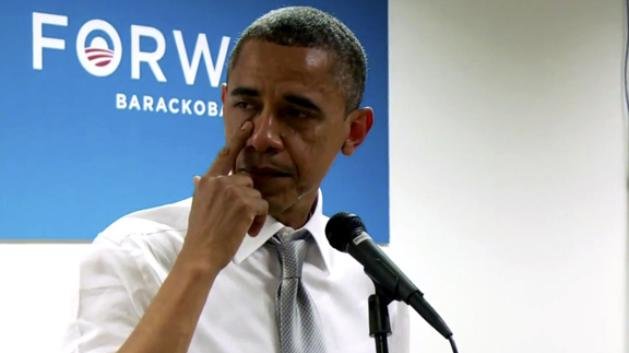
Tearful Obama Credits Staff for History-Books Campaign


The morning after he won re-election, an emotional President Barack Obama credited his youthful staff of several hundred with running a campaign that will "go on in the annals of history."
"What you guys have accomplished will go on in the annals of history and they will read about it and they'll marvel about it," said Obama told his team Wednesday morning inside the Chicago campaign headquarters, tears streaming down his face.
"The most important thing you need to know is that your journey's just beginning. You're just starting. And whatever good we do over the next four years will pale in comparison to whatever you guys end up accomplishing in the years and years to come," he said.
The moment, captured by the Obama campaign's cameras and posted online, offers a rare glimpse at the president unplugged and emotional. During the first four years of his presidency, Obama has never been seen publicly crying.
He first came to Chicago, he told the campaign staff, "knowing that somehow I wanted to make sure that my life attached itself to helping kids get a great education or helping people living in poverty to get decent jobs and be able to work and have dignity. And to make sure that people didn't have to go to the emergency room to get health care."
"The work that I did in those communities changed me much more than I changed those communities because it taught me the hopes and aspirations and the grit and resilience of ordinary people," he said, as senior strategist David Axelrod and campaign manager Jim Messina looked on. "And it taught me the fact that under the surface differences, we all have common hopes and we all have common dreams. And it taught me something about how I handle disappointment and what it meant to work hard on a common endeavor, and I grew up."
"So when I come here and I look at all of you, what comes to mind is, it's not that you guys remind me of myself, it's the fact that you are so much better than I was in so many ways. You're smarter, you're so better organized, you're more effective," he said.
Obama said he expected many of those who helped to re-elect him will assume new roles in progressive politics, calling that prospect a "source of my strength and inspiration."
Senior campaign officials said Thursday that the Obama campaign infrastructure - the field offices and network of hundreds of thousands of volunteers - would undergo a period of transition in the coming weeks to determine how to remain sustainable and influential.
"We have remarkable staff, and the campaign that Jim [Messina] put together, you know, is the best in history," said senior Obama adviser David Plouffe. "But the reason those people got involved was because they believed in Barack Obama. It was the relationship between them and our candidate."

Thursday, 8 November 2012

How did America become so polarized?

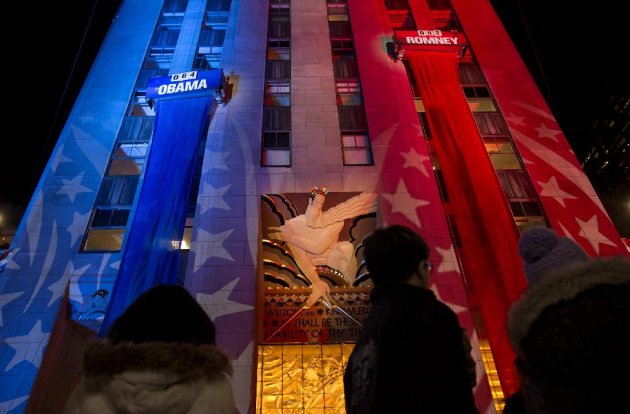
 People watch early election results displayed on a utility lift suspended from the front of the GE Building at Rockefeller Center New York, Tuesday, Nov. 6, 2012. (AP Photo/Craig Ruttle)
WASHINGTON (AP) — The election laid bare a dual — and dueling — nation, politically speaking, jaggedly split down the middle on the presidency and torn over much else. It seems you can please only half of the people nearly all of the time.
Americans retained the fractious balance of power in re-electing President Barack Obama, a Republican House and a Democratic Senate, altogether serving as guarantors of the gridlock that voters say they despise. Slender percentages separated winner and loser from battleground to battleground, and people in exit polls said yea and nay in roughly equal measure to some of the big issues of the day.
Democracy doesn't care if you win big, only that you win. Tuesday was a day of decision as firmly as if Obama had run away with the race. Democrats are ebullient and, after a campaign notable for its raw smackdowns, words of conciliation are coming from leaders on both sides, starting with the plea from defeated Republican rival Mitt Romney that his crestfallen supporters pray for the president.
But after the most ideologically polarized election in years, Obama's assertion Wednesday morning that America is "more than a collection of red states and blue states" was more of an aspiration than a snapshot of where the country stands.
"It's going to take a while for this thing to heal," said Ron Bella, 59, a Cincinnati lawyer who lives in Alexandria, Ky. He is relieved Obama won, but some of his co-workers are in a "sour mood" about it.
"They feel like the vast majority of the country wanted Romney, and the East and the West coasts wanted Obama," he said. "I'm not sure exactly why that is, but there just seems to be such hatred for Obama out there."
Compromise was a popular notion in the hours after Obama's victory and an unavoidable one, given the reality of divided government. But the familiar contours of partisan Washington were also in evidence, especially the notion that compromise means you do things my way.
As Democratic Rep. Steve Israel of New York put it, "If you refuse to compromise, we are going to beat you." Israel, chairman of the Democratic Congressional Campaign Committee, said the election showed "if you are an extremist tea party Republican, you are going to lose."
Senate Republican Leader Mitch McConnell of Kentucky said pointedly that Republicans will meet Obama halfway "to the extent he wants to move to the political center" and propose solutions "that actually have a chance of passing."
In New York's bustling Times Square, hope, skepticism and the usual polarities were all to be found when people talked about the president. "He may not have done a great job in my mind but I kinda trust him," said Jerry Shul. "I have faith he will get with the Republicans and get something done."
A less-flattering George Dallemand called this "a moment of truth" for the country. "I guess we have to wish for the best now, but I still think he is socialism."
In Miami, Karen Fitzgerald, 55, wore a black dress and said she was in mourning over Romney's defeat.
"It's an upsetting day," she said. But she took some comfort from her Democratic friends on Facebook, who have stopped chiding the other side in their posts. "Now they're all saying we need to work together and be united," she said. "Maybe we can."
In Springfield, Ohio, an "elated" Frank Hocker, 67, hoped Republicans would get the message to get out of Obama's way. "There was a backlash," he said. "For this obstructionist House and those tea party people, I hope they learned their lesson. I hope they learned their lesson: Don't stop the progress of this country."
In Chicago, Obama supporter Scherita Parrish, 56, predicted the president will reach out to Republicans but may not get much back.
"But the people have spoken," she said. "They need to lick their wounds, get on with it and start working with the president."
Unity is a challenge not just for Obama but for the Republicans, who won less than 30 percent of the growing Hispanic vote and not even one in 10 black voters. Obama built a strong Electoral College majority, if only a narrow advantage in the popular vote, despite losing every age group of non-Hispanic white voters.
Surveys of voters found Obama's health care law to be as divisive as ever, with just under 50 percent wanting it repealed in whole or part, and 44 percent liking it as is or wanting more of it.
But democracy doesn't care about exit polls, either, and the election almost certainly means Republicans can forget about trying to roll it back now.
In reaffirming divided government, though, Americans all but ensured colossal fights are ahead over the shape of government and Obama's agenda. He is out to break a wall of Republican opposition to tax increases on the wealthy — a move that about half the voters in exit polls thought was a good idea. And extraordinarily difficult negotiations are imminent as the president and Congress try to make a deal to avoid the "fiscal cliff" — steep spending cuts and a variety of tax increases in January.
In the end, voters split about equally on whether Obama or Romney would be better at handling the economy.
Then again, they were divided down the middle on whether Obama or his predecessor, George W. Bush, deserves most of the blame for the economy's problems.
So it goes in the 50-50 nation, give or take.

Wednesday, 7 November 2012

Obama's lease renewed despite tough economic times


WASHINGTON (AP) — His lease renewed in trying economic times, President Barack Obama claimed a second term from an incredibly divided electorate and immediately braced for daunting challenges and progress that comes only in fits and starts.
"We have fought our way back and we know in our hearts that for the United States of America, the best is yet to come," Obama said.
The same voters who gave Obama another four years also elected a divided Congress, re-upping the dynamic that has made it so hard for the president to advance his agenda. Democrats retained control of the Senate; Republicans renewed their majority in the House.
It was a sweet victory for Obama, but nothing like the jubilant celebration of four years earlier, when his hope-and-change election as the nation's first black president captivated the world. This time, Obama ground out his win with a stay-the-course pitch that essentially boiled down to a plea for more time to make things right and a hope that Congress will be more accommodating than in the past.
The vanquished Republican, Mitt Romney, tried to set a more conciliatory tone on the way off the stage.
"At a time like this, we can't risk partisan bickering," Romney said after a campaign filled with it. "Our leaders have to reach across the aisle to do the people's work."
House Speaker John Boehner spoke of a dual mandate, saying, "If there is a mandate, it is a mandate for both parties to find common ground and take steps together to help our economy grow and create jobs."
Senate Republican Leader Mitch McConnell had a more harsh assessment.
"The voters have not endorsed the failures or excesses of the president's first term," McConnell said. "They have simply given him more time to finish the job they asked him to do together" with a balanced Congress.
Obama claimed a commanding electoral mandate — at least 303 electoral votes to 206 for Romney — and had a near-sweep of the nine most hotly contested battleground states.

But the close breakdown in the popular vote showed Americans' differences over how best to meet the nation's challenges. With more than 90 percent of precincts reporting, the popular vote went 50 percent for Obama to 48.4 percent for Romney, the businessman-turned-politician who had argued that Obama had failed to turn around the economy and said it was time for a new approach keyed to lower taxes and a less intrusive government.
Obama's re-election assured certainty on some fronts: His signature health-care overhaul will endure, as will the Wall Street reforms enacted after the economic meltdown. The drawdown of troops in Afghanistan will continue apace. And with an aging Supreme Court, the president is likely to have at least one more nomination to the high court.
The challenges immediately ahead for the 44th president are all too familiar: an economy still baby-stepping its way toward full health, 23 million Americans still out of work or in search of better jobs, civil war in Syria, an ominous standoff over Iran's nuclear program, and more.
Sharp differences with Republicans in Congress on taxes, spending, deficit reduction, immigration and more await.
And even before Obama gets to his second inaugural on Jan. 20, he must grapple with the threatened "fiscal cliff" — a combination of automatic tax increases and steep across-the-board spending cuts that are set to take effect in January if Washington doesn't quickly come up with a workaround budget deal. Economists have warned the economy could tip back into recession absent a deal.
Despite long lines at polls in many places, turnout overall looked to be down from four years ago as the president pieced together a winning coalition of women, young people, minorities and lower-income voters that reflected the country's changing demographics. Obama's superior ground organization in the battleground states was key to his success.
The president's victory speech — he'd written a concession, too, just in case — reflected the realities of the rough road ahead.
"By itself the recognition that we have common hopes and dreams won't end all the gridlock, or solve all our problems or substitute for the painstaking work of building consensus and making the difficult compromises needed to move this country forward," Obama said.
"But that common bond is where we must begin. Our economy is recovering. A decade of war is ending. A long campaign is now over, and whether I earned your vote or not, I have listened to you, I have learned from you and you have made me a better president."
The president said he hoped to meet with Romney and discuss how they can work together. They may have battled fiercely, he said, "but it's only because we love this country deeply."
Romney's short concession — with misplaced confidence, he'd only prepared an acceptance speech — was a gracious end note after a grueling campaign.
He wished the president's family well and told subdued supporters in Boston, "I so wish that I had been able to fulfill your hopes to lead the country in a different direction, but the nation chose another leader and so Ann and I join with you to earnestly pray for him and for this great nation."
Obama's re-election was a remarkable achievement given that Americans are anything but enthusiastic about the state they're in: Only about 4 in 10 voters thought the economy is getting better, just one quarter thought they're better off financially than four years ago and a little more than half think the country is on the wrong track, exit polls showed.
But even now, four years after George W. Bush left office, voters were more likely to blame Bush than Obama for the fix they're in.
It wasn't just the president and Congress who were on the ballot. Voters around the country considered ballot measures on a number of divisive social issues, with Maine and Maryland becoming the first states to approve same-sex marriage by popular vote while Washington state and Colorado legalized recreational use of marijuana.
From the beginning, Obama had an easier path than Romney to the 270 electoral votes needed for victory. The most expensive campaign in history was narrowly targeted at people in nine battleground states that held the key to victory, and the two sides drenched voters there with more than a million ads, the overwhelming share of them negative.
Obama claimed at least seven of the battleground states, most notably Ohio, the Ground Zero of campaign 2012. He also got Iowa, New Hampshire, Colorado, Nevada, Virginia and Wisconsin, and he was ahead in Florida. Romney got North Carolina.
Overall, Obama won 25 states and the District of Columbia and was leading in too-close-to-call Florida. Romney won 24 states.
It was a more measured victory than four years ago, when Obama claimed 365 electoral votes to McCain's 173, winning with 53 percent of the popular vote.
Obama was judged by 53 percent of voters to be more in touch with people like them. More good news for him: Six in 10 voters said that taxes should be increased. And nearly half of voters said taxes should be increased on income over $250,000, as Obama has called for.
Obama's list of promises to keep includes many holdovers he was unable to deliver on in his first term: rolling back tax cuts for upper-income people, immigration reform, reducing federal deficits, and more.
A second term is sure to produce turnover in his Cabinet: Treasury Secretary Timothy Geithner has made it clear he wants to leave at the end of Obama's first term but is expected to remain in the post until a successor is confirmed. Secretary of State Hillary Rodham Clinton, Obama's rival for the presidency four years ago, is ready to leave too. Defense Secretary Leon Panetta isn't expected to stay on.
To the end, the presidential race was a nail-biter. About 1 in 10 voters said they'd only settled on their presidential choice within the last few days or even on Election Day, and they were closely divided between Obama and Romney. Nearly 1 percent of voters went for Libertarian Party candidate Gary Johnson, who was on the ballot in 48 states.
In an election offering sharply different views on the role of government, voters ultimately narrowly tilted toward Obama's approach.
"We have seen growth in the economy," said 25-year-old Matt Wieczorek, a registered Republican from Cincinnati who backed the president. "Maybe not as fast as we want it to be, but Obama has made a difference and I don't want to see that growth come to an end."
Notwithstanding his victory, Obama will lead a nation with plenty of people who were ready for a change.
"The last four years have been crap," said 73-year-old Marvin Cleveland, a Romney supporter in Roseville, Minn. "Let's try something else."
___
Follow Nancy Benac on Twitter: http://www.twitter.com/nbenac

President Obama tweet breaks record

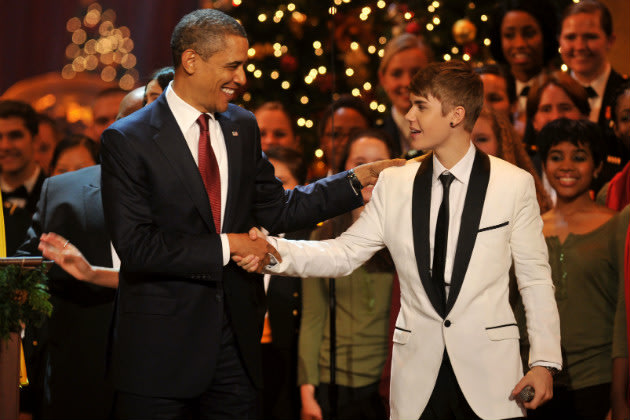
President Obama shakes hands with Justin Bieber during Christmas in Washington, 2011. (Wire Image)
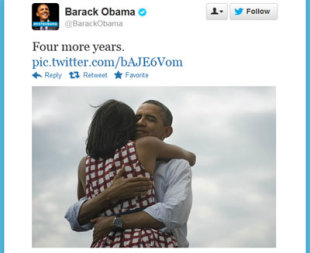
A photo of President Barack Obama hugging first lady Michelle Obama tweeted by the Obama campaign on election night has been retweeted nearly half a million times, likely making it the most shared tweet of all time. The tweet--issued shortly before Obama was projected by several networks to be the winner of Ohio--included the image under the caption, "Four more years."
Obama tweet breaks record
According to AllTwitter.com, the most popular Twitter message before Tuesday was a tweet by Justin Bieber for Avalanna Routh, a six-year-old fan of the pop star who died of cancer.
"RIP Avalanna," Bieber wrote on Sept. 12."i love you."
While President Obama's Twitter feed technically now holds the most popular tweet of all-time, Obama himself does not. Personal tweets from the president are signed "-bo," like the tweet, published several minutes before the photo, thanking his supporters. It read: "We're all in this together. That's how we campaigned, and that's who we are. Thank you. -bo"
That tweet was retweeted more than 141,000 times.

Tuesday, 6 November 2012

Barack Obama wins election for second term as president


President Barack Obama handily defeated Gov. Mitt Romney and won himself a second term Tuesday after a bitter and historically expensive race that was primarily fought in just a handful of battleground states. Obama beat Romney after nabbing almost every one of the 12 crucial battleground states.
In a sweeping victory speech early Wednesday morning, Obama thanked every American who voted, and vowed to work with leaders from both parties to tackle the country's challenges.
"Our economy is recovering, a decade of war is ending, a long campaign is now over," he told a crowd of cheering supporters in Chicago. "And whether I earned your vote or not, I have listened to you, I have learned from you and you have made me a better president." Obama added he has "never been more hopeful about America. ... We're not as divided as our politics suggest. We remain more than a collection of blue states and red states."
Romney conceded in Boston in an earlier speech around 1 AM ET. "Like so many of you, Paul [Ryan] and I have left everything on the field. We have given our all to this campaign," Romney said. "I so wish that I had been able to fulfill your hopes to lead your country in another direction. But the nation chose another leader." Romney congratulated the president and his campaign on their victory.
The Romney campaign's last-ditch attempt to put blue-leaning Midwestern swing states in play failed as Obama's Midwestern firewall sent the president back to the White House for four more years. Obama picked up the swing states of New Hampshire, Michigan, New Mexico, Iowa, Virginia, Wisconsin, Colorado, Nevada, Pennsylvania, Minnesota and Ohio. Of the swing states, Romney only picked up North Carolina. Florida is still too close to call, but even if Romney won the state, Obama still handily beats him in the Electoral College vote. The popular vote will most likely be narrower than the president's decisive Electoral College victory.
The Obama victory marks an end to a years-long campaign that saw historic advertisement spending levels, countless rallies and speeches, and three much-watched debates.
The Romney campaign cast the election as a referendum on Obama's economic policies, frequently comparing him to former President Jimmy Carter and asking voters the Reagan-esque question of whether they are better off than they were four years ago. But the Obama campaign pushed back, blanketing key states such as Ohio early on with ads painting him as a multimillionaire more concerned with profits than people. The Obama campaign also aggressively attacked Romney on reproductive rights issues, tying Romney to a handful of Republican candidates who made controversial comments about rape and abortion.
The ads were one reason Romney faced a steep likeability problem for most of the race, until his expert performance at the first presidential debate in Denver in October. After that debate, and a near universal panning of Obama's performance, Romney caught up with Obama in national polls, and almost closed his favorability gap with the president. In polls, voters consistently gave him an edge over Obama on who would handle the economy better and create more jobs, even as they rated Obama higher on caring about the middle class.
But the president's Midwestern firewall—and the campaign's impressive grassroots operation—carried him through. Ohio tends to vote a bit more Republican than the nation as a whole, but Obama was able to stave off that trend and hold an edge there over Romney, perhaps due to the president's support of the auto bailout three years ago. Romney and his running mate Paul Ryan all but moved to Ohio in the last weeks of the campaign, trying and ultimately failing to erase Obama's lead there.
A shrinking electoral battleground this year meant that only 12 states were really seen as in play, and both candidates spent most of their time and money there. Though national polls showed the two candidates in a dead heat, Obama consistently held a lead in the states that mattered. That, and his campaign's much-touted get-out-the-vote efforts and overall ground game may be what pushed Obama over the finish line.
Now, Obama heads back to office facing what will most likely be bitterly partisan negotiations over whether the Bush tax cuts should expire. The House will still be majority Republican, with Democrats maintaining their majority in the Senate.
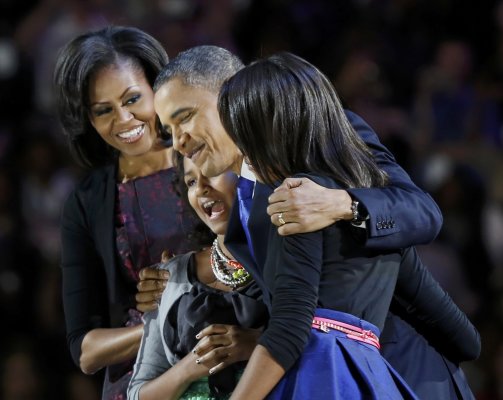
President Obama hugs daughters at victory rally in Chicago

Obama wins second term, Romney concedes defeat

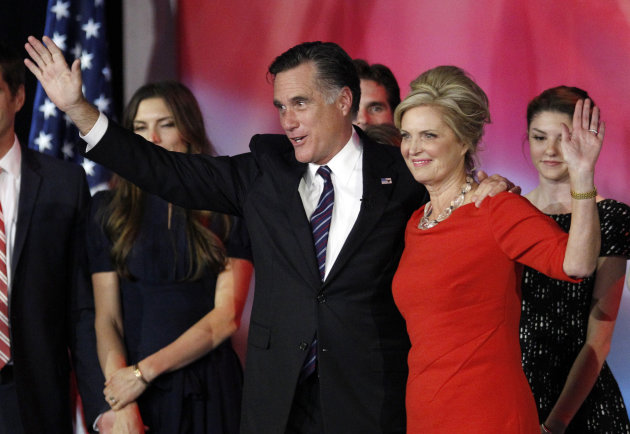
Republican presidential candidate and former Massachusetts Gov. Mitt Romney and his wife Ann Romney wave to supporters after Romney conceded the race at his election night rally, Wednesday, Nov. 7, 2012, in Boston. (AP Photo/Stephan Savoia)
WASHINGTON (Reuters) - President Barack Obama won a second term in the White House on Tuesday, overcoming deep doubts among voters about his handling of the U.S. economy to score a clear victory over Republican challenger Mitt Romney.
Americans chose to stick with a divided government in Washington, by keeping the Democratic incumbent in the White House and leaving the U.S. Congress as it is, with Democrats controlling the Senate and Republicans keeping the House of Representatives.
Obama told thousands of supporters in Chicago who cheered his every word that "we have picked ourselves up, we have fought our way back" and that for America, the best is yet to come.
He vowed to listen to both sides of the political divide in the weeks ahead and said he would return to the White House more determined than ever to confront America's challenges.
"Whether I earned your vote or not, I have listened to you, I have learned from you. And you have made me a better president," Obama said.
The nationwide popular vote remained extremely close with Obama taking about 50 percent to 49 percent for Romney after a campaign in which the candidates and their party allies spent a combined $2 billion.

Romney, the multimillionaire former private equity executive, came back from a series of campaign stumbles to make it close after besting the president in the first of three presidential debates.
The 65-year-old former Massachusetts governor conceded in a gracious speech delivered to disappointed supporters at the Boston convention center. He had called Obama to concede defeat after a brief controversy over whether the president had really won Ohio.
"This is a time of great challenge for our nation," Romney told the crowd. "I pray that the president will be successful in guiding our nation."
He warned against partisan bickering and urged politicians on both sides to "put the people before the politics."
Obama told his crowd that he hoped to sit down with Romney in the weeks ahead and examine ways to meet the challenges ahead.
The president Obama scored impressive victories in the crucial state of Ohio and heavily contested swing states of Virginia, Nevada, Iowa and Colorado. They carried the Democrat past the 270 electoral votes needed for victory in America's state-by-state system of choosing a president, and left Romney's senior advisers shell-shocked at the loss.
Obama, America's first black president, won by convincing voters to stick with him as he tries to reignite strong economic growth and recover from the worst recession since the Great Depression of the 1930s. An uneven recovery has been showing some signs of strength but the country's 7.9 percent jobless rate remains stubbornly high.
Obama's victory in the hotly contested swing state of Ohio - as projected by TV networks - was a major step in the fight for the 270 electoral votes needed to clinch the White House and ended Romney's hopes of pulling off a string of swing-state upsets.
Obama scored narrow wins in Ohio, Wisconsin, Iowa, Pennsylvania and New Hampshire - all states that Romney had contested - while the only swing state captured by Romney was North Carolina, according to television network projections.
Romney initially delayed his concession as some Republicans questioned whether Obama had in fact won Ohio despite the decisions by election experts at all the major TV networks to declare it for the president.
The later addition of Colorado and Virginia to Obama's tally - according to network projections - meant that even if the final result from Ohio were to be reversed, Romney still could not reach the needed number of electoral votes.
While Obama supporters in Chicago were ecstatic, Romney's Boston event was grim as the news was announced on television screens there. A steady stream of people left the ballroom at the Boston convention center.
THE SAME PROBLEMS
At least 120 million American voters had been expected to cast votes in the race between the Democratic incumbent and Romney after a campaign that was focused on how to repair the ailing U.S. economy.
The same problems that dogged Obama in his first term are still there to confront him again.
He faces a difficult task of tackling $1 trillion annual deficits, reducing a $16 trillion national debt, overhauling expensive social programs and dealing with a gridlocked U.S. Congress that kept the same partisan makeup.
Obama's Democrats held their Senate majority - taking hotly contested Republican-held seats in Massachusetts and Indiana - while the Republicans kept House control.
Democrat Claire McCaskill retained her U.S. Senate seat from Missouri, beating Republican congressman Todd Akin, who stirred controversy with his comment in August that women's bodies could ward off pregnancy in cases of "legitimate rape.
Democrats gained a Senate seat in Indiana that had been in Republican hands for decades after Republican candidate Richard Mourdock called pregnancy from rape something that God intended. Democratic congressman Joe Donnelly won the race.
In another high-profile Senate race, Democrat Elizabeth Warren, a law professor who headed the watchdog panel that oversaw the government's financial sector bailout, defeated incumbent Massachusetts Republican Senator Scott Brown.
Former Maine Governor Angus King won a three-way contest for the Senate seat of retiring Republican Olympia Snowe. King ran as an independent, but he is expected to caucus with Democrats in what would amount to a Democratic pick-up.
Florida Democratic Senator Bill Nelson easily beat back a challenge from Republican congressman Connie Mack to win a third term, while Democratic congressman Chris Murphy beat Republican Linda McMahon, a businesswoman who had served as chief executive of a professional wrestling company.
Democrats were also cheered by several state referendums. Maryland voters approved same-sex marriage, the governor said, and a similar measure in Maine appeared on track to pass as well - marking the first time marriage rights have been extended to same-sex couples by popular vote.
In addition, Wisconsin Democratic congresswoman Tammy Baldwin became the first openly gay U.S. Senator, defeating Republican former governor Tommy Thompson.
(Additional reporting by Jeff Mason in Chicago, Patricia Zengerle in Boston, Edith Honan in New York, Brendan O'Brien in Milwaukee, Dave Warner in Philadelphia, Philip Barbara in New Jersey, Matt Spetalnick, Lisa Lambert, Susan Heavey, Thomas Ferraro, Susan Cornwell, Anna Yukhananov and Roberta Rampton in Washington; Writing by Steve Holland and John Whitesides; Editing by Claudia Parsons and Will Dunham)

A phone call crosses the political divide

 President Barack Obama, accompanied by singer Bruce Springsteen, waves as he arrive at a campaign event near the State Capitol Building in Madison, Wis., Monday, Nov. 5, 2012. (AP Photo/Pablo Martinez Monsivais)
KEANSBURG, N.J. (AP) — New Jersey's famously tough-talking governor finally got a hug from his longest-running unrequited love.
Speaking Monday at a briefing on storm recovery. Gov. Chris Christie revealed he unexpectedly spoke with Bruce Springsteen earlier in the day. Christie had been discussing storm-related matters with President Barack Obama when Obama handed the phone to Springsteen, who was traveling with him as part of a campaign trip.
Christie also said he got a hug from Springsteen at Friday's benefit concert for storm victims.
The famously liberal Springsteen had never previously acknowledged the Republican governor. Christie considers himself among The Boss' biggest fans and has attended more than 100 of his concerts.
Christie has praised Obama's handling of the storm, while continuing to back Mitt Romney.
Christie says he wept at home after meeting his idol, calling it a major highlight during a tough week.

Obama, Romney focus on swing states in late campaigning


WASHINGTON (Reuters) - President Barack Obama and Republican challenger Mitt Romney engaged in frantic get-out-the-vote efforts and made final pleas to voters on Monday in a sprint through battleground states that will determine who wins their agonizingly close White House race.
Both candidates sought to generate strong turnout from supporters and to sway independent voters to their side in the last hours of a race that polls showed was deadlocked nationally. Obama had a slight lead in the eight or nine battleground states that will decide the race on Tuesday's Election Day.
The latest Reuters/Ipsos national poll of likely voters, a daily tracking poll, gave Obama a slight edge, with 48 percent support compared to Romney's 46 percent. The difference was within the 3.4 percentage point credibility interval, which allows for statistical variation in Internet-based polls.
Obama was up 4 percentage points in must-win Ohio, 50 percent to 46 percent, and held slimmer leads in Virginia and Colorado. Romney led in Florida by 1 percentage point, the poll found.
The president, with a final day itinerary that included stops in Wisconsin, Ohio and Iowa, urged voters to stick with him and trust that his economic policies are working. Traveling with him was rocker Bruce Springsteen.
"Ohio, I'm not ready to give up on the fight. I've got a whole lot of fight left in me and I hope you do too," Obama told supporters in Columbus, Ohio.
Romney's final day included stops in Florida, Virginia, Ohio and New Hampshire. He pledged that he would handle the economy better than Obama and jabbed his opponent for blaming Republican predecessor George W. Bush for the weak economy.
"I won't waste any time complaining about my predecessor. And I won't spend my time trying to pass partisan legislation rather than working to help America get back to work," Romney said in Fairfax, Virginia.
The candidates are seeking to piece together the 270 Electoral College votes needed for victory in the state-by-state battle for the presidency. Despite the close national opinion polls, Obama has an easier path to victory: If he won the three states he was visiting on Monday - Wisconsin, Ohio and Iowa - then he would likely carry the day.
OHIO COULD BE DECISIVE
All eyes were on the Midwestern state of Ohio, whose 18 electoral votes could be decisive. Romney, looking for any edge possible, planned last-second visits on Tuesday to both Ohio and Pennsylvania, aides said.
Visits to the areas around Cleveland and Pittsburgh would be aimed at driving turnout. And the Pittsburgh stop could be as much about Ohio as Pennsylvania, since many in eastern Ohio watch Pittsburgh television.
Romney's path to the White House becomes much harder should he lose Ohio. The state has been leaning toward Obama - its unemployment rate is lower than the 7.9 percent national average and its heavy dependence on auto-related jobs meant the bailout to auto companies that Obama pursued in 2009 is popular.
Both campaigns expressed confidence that their candidate would win, and there were enough polls to bolster either view.
There were clear signs that Obama held an edge. A CNN/ORC poll, for instance, showed him up in Ohio by 50 percent to 47 percent.
The close margins in state and national polls suggested the possibility of a cliffhanger that could be decided by which side has the best turnout operation and gets its voters to the polls.
CHALLENGES AHEAD
Whoever wins will have a host of challenges to confront. The top priority will be the looming "fiscal cliff" of spending cuts and tax increases that would begin with the new year.
The balance of power in Congress also will be at stake on Tuesday, with Obama's Democrats now expected to narrowly hold their Senate majority and Romney's Republicans favored to retain control of the House of Representatives.
In a race where the two candidates and their party allies raised a combined $2 billion, the most in U.S. history, both sides have pounded the heavily contested battleground states with an unprecedented barrage of ads.
(Additional reporting by Jeff Mason and Patricia Zengerle; Editing by Alistair Bell, Frances Kerry and Cynthia Osterman)

No rest in final campaign hours for Obama, Romney

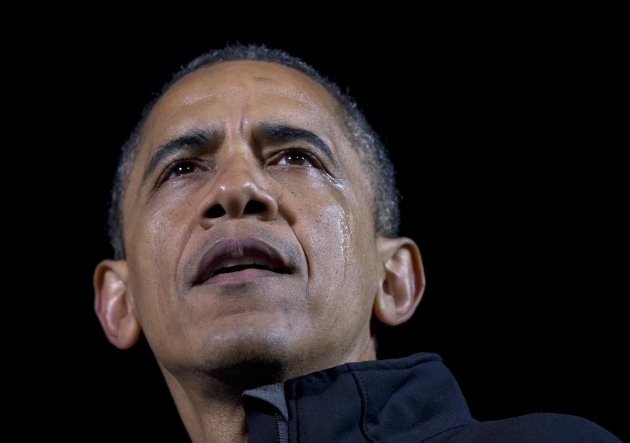
President Barack Obama speaks, as a tear streams down his face, at his final campaign stop on the evening before the 2012 presidential election, Monday, Nov. 5, 2012, in Des Moines, Iowa. (AP Photo/Carolyn Kaster)
DES MOINES, Iowa (AP) — The White House the prize, President Barack Obama and Mitt Romney raced through a final full day of campaigning on Monday through Ohio and other battleground states holding the keys to victory in a tight race. Both promised brighter days ahead for a nation still struggling with a sluggish economy and high joblessness.
"I've come back to Iowa one more time to ask for your vote," Obama told 20,000 supporters at an outdoor rally in Des Moines, the last of his campaign. "This is where our movement for change began."
A single tear ran down Obama's face as he spoke. Whether it was the product of emotion or the bitter cold was hard to tell.
In a final rally of his own Monday night, Romney told supporters in New Hampshire — he won the state's first-in-the-nation primary — that he needs their votes again.
"It's all your votes and your work right here in New Hampshire that will help me become the next president of the United States," Romney told a capacity crowd at the 10,000-seat Verizon Wireless Arena. "We thank you and we ask you to stay in it all the way to the victory tomorrow night."
With many of the late polls in key states tilting slightly against him, Romney decided to campaign on Election Day in Ohio and Pennsylvania, where he and Republicans made a big, late push.
The presidency aside, there are 33 Senate seats on the ballot Tuesday, and according to one Republican official, a growing sense of resignation among his party's rank and file that Democrats will hold their majority.
The situation was reversed in the House, where Democrats made no claims they were on the verge of victory in pursuit of the 25 seats they need to gain control.
National opinion polls in the presidential race made the popular vote a virtual tie.
Fitting for a tight election, voters in tiny Dixville Notch, N.H., split over the candidates, Obama and Romney receiving five votes each when balloting took place at midnight. In nearby Hart's Location, the hamlet that shares the honor of casting the nation's first presidential ballots, Obama won with 23 votes, Romney received nine and Libertarian Gary Johnson received one.
In state-by-state surveys, it appeared Obama held small advantages in Nevada, Ohio, Iowa and Wisconsin — enough to deliver a second term if they endured, but not so significant that they could withstand an Election Day surge by Romney supporters. Both men appealed to an ever smaller universe of undecided voters.
More than 30 million absentee or early ballots have been cast, including in excess of 3 million in Florida. The state also had a legal controversy, in the form of a Democratic lawsuit seeking an extension of time for pre-Election Day voting.
There were other concerns, logistical rather than legal.
Officials in one part of New Jersey delivered voting equipment to emergency shelters so voters displaced by Superstorm Sandy last week could cast ballots. New York City made arrangements for shuttle buses to provide transportation for some in hard-hit areas unable to reach their polling places.
Judging from the long early voting lines in some places and the comments made in others, the voters were more than ready to have their say.
"I watch the news all the time, and I am ready for it to be over," said Jennifer Walker, 38, of Columbus, Ohio, who said she took time off from work to attend the president's speech during the day in a show of support. "I feel like he is getting better with the economy. I don't think it's hopeless. It takes time."
But Bryan Dobes, 21, a University of Iowa student from suburban Chicago, voted for Romney on Monday and said unemployment and spending have been too high under Obama. "He promised a lot of hope and change, and I'm not seeing it," he said of the president.
"No retreat, no surrender," sang rock icon Bruce Springsteen, warming up Obama's crowd on a frosty morning outside the State Capitol in Madison, Wis. The Boss then boarded Air Force One for his first flight. "Pretty cool," he judged it.
Romney had Kid Rock and the Marshall Tucker Band in the wings for his late appearances in Ohio and New Hampshire.
"This is it," the challenger said in a last-minute emailed request for campaign donations.
"I will lead us out of this economic crisis by implementing pro-growth policies that will create 12 million new jobs. With your help, I will deliver real change and a real recovery. America will be strong again."
In his longest campaign day, Romney raced from Florida to a pair of speeches in Virginia to Ohio and then an election eve rally in New Hampshire.
Obama selected Wisconsin, Ohio and Iowa for his final campaign day, an itinerary that reflected his campaign's decision to try and erect a Midwestern firewall against Romney's challenge.
Vice President Joe Biden and Republican running mate Paul Ryan of Wisconsin went through their final campaign paces, as well.
In Sterling, Va., not far from Washington, the vice president accused Republicans of running away from their record, but added, "a leopard can't change his spots."
Ryan started out in Reno, Nev., where he said the president has come up short in his promises to change Washington and repair the economy.
"This may be the best that Barack Obama can offer, but this is not the best America can," he said, before flying off to Colorado and Ohio. Then it was home to Wisconsin, where he is on the ballot for re-election to Congress in case Republicans were unsuccessful in the presidential campaign.
Conscientious to the end, supporters kept knocking on doors in search of a possibly decisive vote.
In Enfield, N.H., Obama volunteer Sarah Ayres recalled driving up a deserted dirt road, unsure if she would find the house she was looking for. She turned down a long driveway, she said, got out of her car, and was met by a friendly, white goat.
"There were no people home, but the goat was there, so I don't know if I should count that as a contact," she joked.

Monday, 5 November 2012

Protesters removed from Obama rally in Ohio


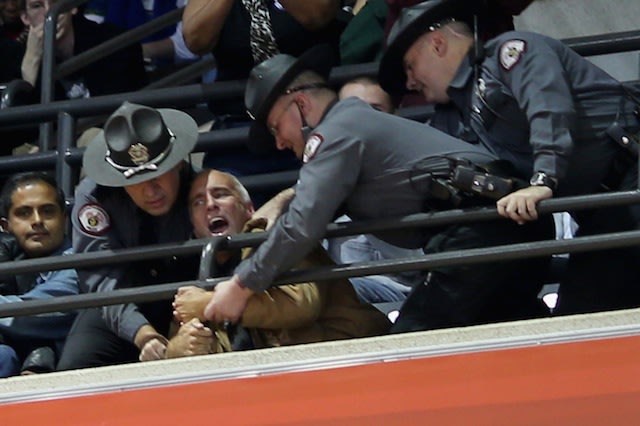
Security officials remove a protester at President Barack Obama's campaign rally in Cincinnati. (Chip Somodevilla/Getty …
CINCINNATI—At least two protesters were removed from a rally for President Barack Obama here on Sunday after they interrupted his speech by shouting from the bleachers.
A few moments into Obama's address at the University of Cincinnati basketball arena, a man seated in the upper rafters stood up and began shouting down the president about abortion while holding an upside down sign reading, "This Moral Wrong Should Never Be A Constitutional Right"
The crowd of 13,500 drowned him out with a chant of "Four more years!" and the incident forced the president to stop his speech. The man continued shouting until five police offers hauled him out of the arena. When Obama began speaking again, another man on the other side of the arena tried to shout him down again, but was quickly escorted out.
"These might have been some Tennessee Titans fans who were mad about the Bears beating them really badly today," Obama joked, before resuming his speech.
Obama's Sunday evening rally was the second-to-last time he will campaign in this state, which both he and Republican Mitt Romney view as crucial to winning the election on Tuesday.
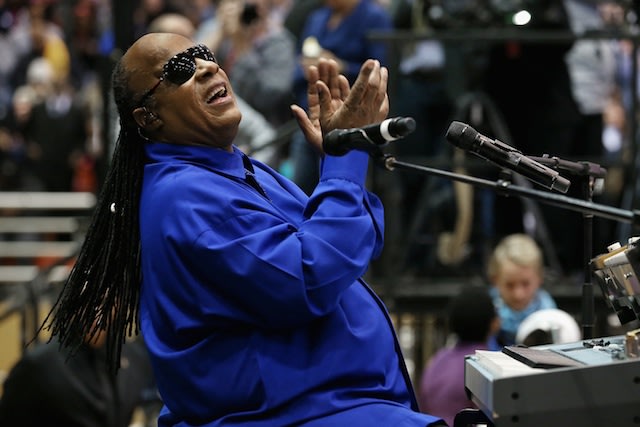
Stevie Wonder (Chip Somodevilla/Getty Images)
Joining the president was musician Stevie Wonder, who entertained the crowd before Obama's speech and played a set when he finished. Between numbers, Wonder slammed Romney for comments he made last spring at a private fundraiser, specifically about how "47 percent" of the population would never support the GOP challenger.
"When I hear somebody talking about the 47 percent don't matter, that's unacceptable," Wonder said. He also discussed abortion policy: "Men are making an issue about the woman's body. The reality is, I know—and all us men in here know—that if women were taking control of our bodies making decisions, we wouldn't like that. Is this too real or can you handle it?"
With that, he and his band performed "A Time to Love."
Obama will return to the state on Monday for a final rally in Columbus.
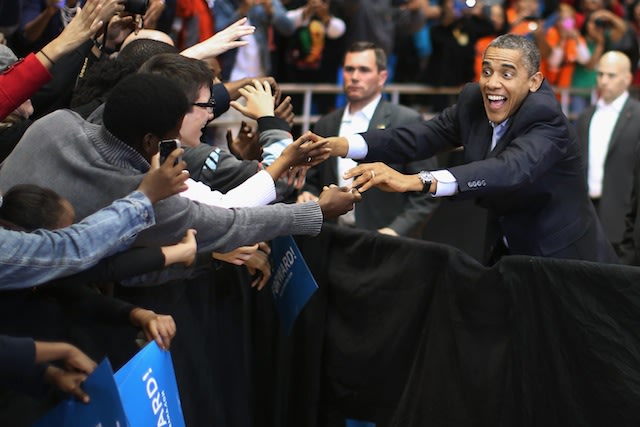
President Barack Obama greets supporters in Cincinnati. (Chip Somodevilla/Getty Images)

US candidates rush into final day of campaign


Obama and Romney will each visit several key battleground states; latest polls show Obama leading in many of them.


The latest state-level polls have not been encouraging for Romney: They show Obama leading key battlegrounds [Reuters]
US president Barack Obama and his Republican challenger Mitt Romney launched into their final day of campaigning on Monday, hours ahead of a close election which polls nonetheless suggest will tip in Obama's favour.
Both candidates planned to barnstorm through a handful of key "swing states," as they have for the past few weeks.
Romney started his day in the central Florida city of Sanford, and planned to stop in Virginia and Ohio before a final rally in New Hampshire.
"Tomorrow we begin a new tomorrow," Romney said at his Florida rally. "This nation is going to begin to change for the better tomorrow. Your work is making a difference."
Obama's first appearance was a rally in Madison, Wisconsin, a college town and liberal stronghold. From there he would travel to Iowa, and then to a final event in Ohio.
The two men both enlisted some celebrities for their final performances: Bruce Springsteen and Jay-Z will headline Obama's event, while Romney's will feature Kid Rock and the Marshall Tucker Band, a country music group.
Both campaigns held a total of 14 events yesterday across eight states, nearly half of them in Ohio.
Obama leading in key states
The last round of national polls were good news for the president. A Pew Research Center poll showed him leading Romney by three points, 48 per cent to 45 per cent. The same poll had them tied last week.
Two other polls showed a closer race: A Washington Post-ABC News poll had Obama leading by one point, 49 per cent to 48 per cent; and a CNN poll had the candidates tied with 49 per cent of the vote.
All three of those results were within the polls' margins of error.
But the popular vote will not decide the outcome. States are apportioned a number of electoral votes based on their population, and the candidate who wins a majority - 270 -  becomes president. And the final state polls showed the president leading in most of the crucial swing states.
Surveys in Ohio had him leading by anywhere from three to five points. A victory there would force Romney to win at least six of the remaining eight battleground states, which seems unlikely: Obama led every poll conducted in Iowa, New Hampshire, Nevada, Virginia and Wisconsin; Romney's lone bright spot was North Carolina, where he looks poised to win by a narrow margin.
The other two battlegrounds, Colorado and Florida, seem too close to predict, with polls showing a range of possible outcomes.

Obama, Romney to make their final case on last day of race

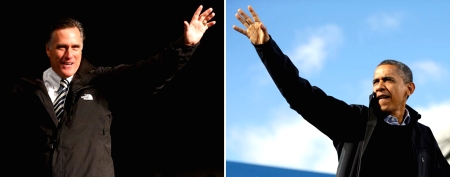
Mitt Romney and Barack Obama. (AP Photo)
WASHINGTON (Reuters) - President Barack Obama and Republican challenger Mitt Romney make a frenetic dash to a series of crucial swing states on Monday, delivering their final arguments to voters on the last day of an extraordinarily close race for the White House.
After a long, bitter and expensive campaign, national polls show Obama and Romney are essentially deadlocked ahead of Tuesday's election, although Obama has a slight advantage in the eight or nine battleground states that will decide the winner.
Obama plans to visit three of those swing states on Monday and Romney will travel to four to plead for support in a fierce White House campaign that focused primarily on the lagging economy but at times turned intensely personal.
The election's outcome will impact a variety of domestic and foreign policy issues, from the looming "fiscal cliff" of spending cuts and tax increases that could kick in at the end of the year to questions about how to handle illegal immigration or the thorny challenge of Iran's nuclear ambitions.
The balance of power in Congress also will be at stake on Tuesday, with Obama's Democrats now expected to narrowly hold their Senate majority and Romney's Republicans favored to retain control of the House of Representatives.
In a race where the two candidates and their party allies raised a combined $2 billion, the most in U.S. history, both sides have pounded the heavily contested battleground states with an unprecedented barrage of ads.
The close margins in state and national polls suggested the possibility of a cliffhanger that could be decided by which side has the best turnout operation and gets its voters to the polls.
In the final days, both Obama and Romney focused on firing up core supporters and wooing the last few undecided voters in battleground states.
Romney reached out to dissatisfied Obama supporters from 2008, calling himself the candidate of change and ridiculing Obama's failure to live up to his campaign promises. "He promised to do so very much but frankly he fell so very short," Romney said at a rally in Cleveland, Ohio, on Sunday.
Obama, citing improving economic reports on the pace of hiring, argued in the final stretch that he has made progress in turning around the economy but needed a second White House term to finish the job. "This is a choice between two different versions of America," Obama said in Cincinnati, Ohio.
FINAL SWING-STATE BLITZES
Obama will close his campaign on Monday with a final blitz across Wisconsin, Ohio and Iowa - three Midwestern states that, barring surprises elsewhere, would be enough to get him more than the 270 electoral votes needed for victory.
Polls show Obama has slim leads in all three. His final stop on Monday night will be in Iowa, the state that propelled him on the path to the White House in 2008 with a victory in its first-in-the nation caucus.
Romney will visit his must-win states of Florida and Virginia - where polls show he is slightly ahead or tied - along with Ohio before concluding in New Hampshire, where he launched his presidential run last year.
The only state scheduled to get a last-day visit from both candidates is Ohio, the most critical of the remaining battlegrounds - particularly for Romney.
The former Massachusetts governor has few paths to victory if he cannot win in Ohio, where Obama has kept a small but steady lead in polls for months.
Obama has been buoyed in Ohio by his support for a federal bailout of the auto industry, where one in every eight jobs is tied to car manufacturing, and by a strong state economy with an unemployment rate lower than the 7.9 percent national rate.
That has undercut Romney's frequent criticism of Obama's economic leadership, which has focused on the persistently high jobless rate and what Romney calls Obama's big spending efforts to expand government power.
Romney, who would be the first Mormon president, has centered his campaign pitch on his own experience as a business leader at a private equity fund and said it made him uniquely suited to create jobs.
Obama's campaign fired back with ads criticizing Romney's experience and portraying the multimillionaire as out of touch with everyday Americans.
Obama and allies said Romney's firm, Bain Capital, plundered companies and eliminated jobs to maximize profits. They also made an issue of Romney's refusal to release more than two years of personal tax returns.

Saturday, 3 November 2012

African-American voters weigh in on Obama

The NBC News/Wall Street Journal poll in the summer that found Barack Obama leading Mitt Romney among black voters, 94 per cent-to-zero, seemed almost unbelievable – really, zero?
But in dozens of interviews with black voters across the country - in coffeeshops in North Carolina, churches in Florida, college campuses in Colorado – I didn’t find one who planned to vote for Romney. Not a single one.
This doesn’t make for a terribly interesting story, mostly because it is a reflection of long-standing political preferences. Al Gore picked up 90 per cent of the black vote in 2000; John Kerry got 88 per cent in 2004.
Over the past five decades, only one Republican candidate has picked up more than 15 per cent of the African-American vote - and that was George HW Bush, in 1988, against the wildly unpopular Michael Dukakis.
Below, a group of black voters from across the US share their thoughts on the election and Obama's first term.

Their reasons for supporting the president are varied: some say they appreciate his efforts to help the economy; others talked about his health care reforms; still others brought up his liberal views on social issues like abortion and same-sex marriage.

William Barber

Barber is the president of the North Carolina branch of the National Association for the Advancement of Colored People (NAACP).
He rejected the idea that Barack Obama hasn't done enough as president to combat poverty, saying that the president "fought an entrenched Republican-led Congress" to pass bills like his $787 stimulus package and health care reforms which have had a major impact on the poor.

Tyrone Gardner

Gardner reminisced about election night 2008, and how it felt to know that "someone who looks like me" could become president.
He blamed the Republican party for many of Obama's failures. "I don't even understand how they sleep at night," he said, going on to praise several of Obama's policies, like the health care bill. "You always hear the negative. You never hear the good stuff that he does," Gardner said.

Thaddeus Washington

Washington, an air force veteran from Goldsboro, North Carolina, described Obama as "a president under a microscope," and argued that racism was behind much of the opposition to his policies.
Washington did say enthusiasm would be lower for this election than in 2008. "My gut tells me it won't be the same, because there was an extra added electricity on the fact that, here was a black man, for the first time, potentially becoming the president," he said.

Sylvia Barnes

Barnes, a retired army reservist, said people "don't know the impact" of some of the president's policies, like his health care law.
She was particularly concerned about Romney's views on entitlement programmes like Medicare and Social Security. "If we don't get someone in there that's going to continue with [those programmes], the impact that will have..." she said, trailing off.

William Lucas

Lucas, a Florida resident, predicted that voter turnout in the African-American community would be 75 per cent of what it was in 2008.
"That's unfortunate, but I think that people tend to be discouraged by things that have occurred," he said. "They know it's not his fault, but it's the fact that they're giving him very little time to accomplish a great big mission."

Francine Smith

Smith, a community organiser, remembered the pride she felt when Obama won in 2008, and talked about how her parents and grandparents might have felt about that moment.
She described herself as "extremely proud" of the president. "I never expected miracles. Because of the work that I do, I know the work he had in front of him... it was a huge amount of things that needed to be addressed."

Joy Adroa

Adroa, a college student in Colorado, said that many of her peers were less enthusiastic about Obama - which she described as inevitable, given the challenges facing the country.
"It was already hard for anyone who might have been elected to come in and really do much... I think he's done well since, from having to start there."

Treding Now